Every rebrand, whether it costs millions or comes out of a school activities budget, eventually runs into the same unglamorous problem: physically removing the old brand. The most useful mascot rebrand lessons rarely come from the logo reveal. They come from the months of cleanup that follow, when leftover identity still lives on floors, signage, merchandise, and digital surfaces.
That is why a small Minnesota school district belongs in the same conversation as the Washington Commanders and Cleveland Guardians. The budgets are wildly different. The removal playbook is not.

Short Stereo works with brands on exactly this less-glamorous half of rebranding, the rollout, the touchpoint inventory, the sequencing, which is why a story like Esko's is worth reading alongside major sports rebrands instead of past it. Local coverage from the Pine Journal in Cloquet has tracked the district's campus cleanup as the deadline approaches.
The News: A Small Minnesota School Nears the Finish Line on a Full Rebrand
Esko Public Schools, a small district near Duluth, Minnesota, is closing in on the final phase of removing its retired Eskomos mascot and igloo imagery from campus. The process was forced by a 2023 state law banning Native American mascots in Minnesota schools. According to reporting on the district's progress, the old branding was woven deeply into everyday campus life: the gym floor, the stadium, the commons area carpet, even the clocks.
It is a small, local story. It is also a near-perfect case study in something much bigger brands deal with constantly: the difference between announcing a rebrand and actually finishing one. The board retired the nickname in 2023. Teams have competed simply as Esko while leftover imagery lingered. Now the physical work is catching up to the decision.
That lag is familiar. Most organizations treat the announcement as the milestone, then discover that identity removal is a project of its own. Esko is living through that discovery in public, under a hard deadline, which makes the logistics unusually visible.
Why This Story Belongs Next to the Washington Commanders and Cleveland Guardians
Same playbook, wildly different budgets
The Washington Commanders' 2022 name change and the Cleveland Guardians' 2021 rebrand are two of the most-cited examples of a full sports-brand transition: new name, new visual identity, and a slow, expensive process of replacing every physical and digital touchpoint that carried the old brand. Esko is running the exact same playbook, just without an NFL or MLB budget behind it.
That comparison matters for founders, CMOs, and design leads. If you only study franchise-scale rebrands, you can assume the hard part is creative direction. Esko shows that the hard part is often logistics: inventory, funding, sequencing, and community patience while the old brand disappears in stages.
A legal deadline forces a timeline most brands never get
Esko's rebrand is not optional or self-paced. It is tied to a hard state deadline, later adjusted into 2026. Most companies never get that kind of external forcing function, which is often exactly why brand transitions drag on for years past their official announcement.
Deadlines force prioritization. Without one, teams keep the easy digital updates and postpone the expensive physical ones. Stadium boards, packaging dies, storefront vinyl, and employee gear become "phase two" forever. Esko does not have that luxury, and that pressure is part of why the story teaches so clearly.
What Actually Happens When a Brand Gets Physically Removed
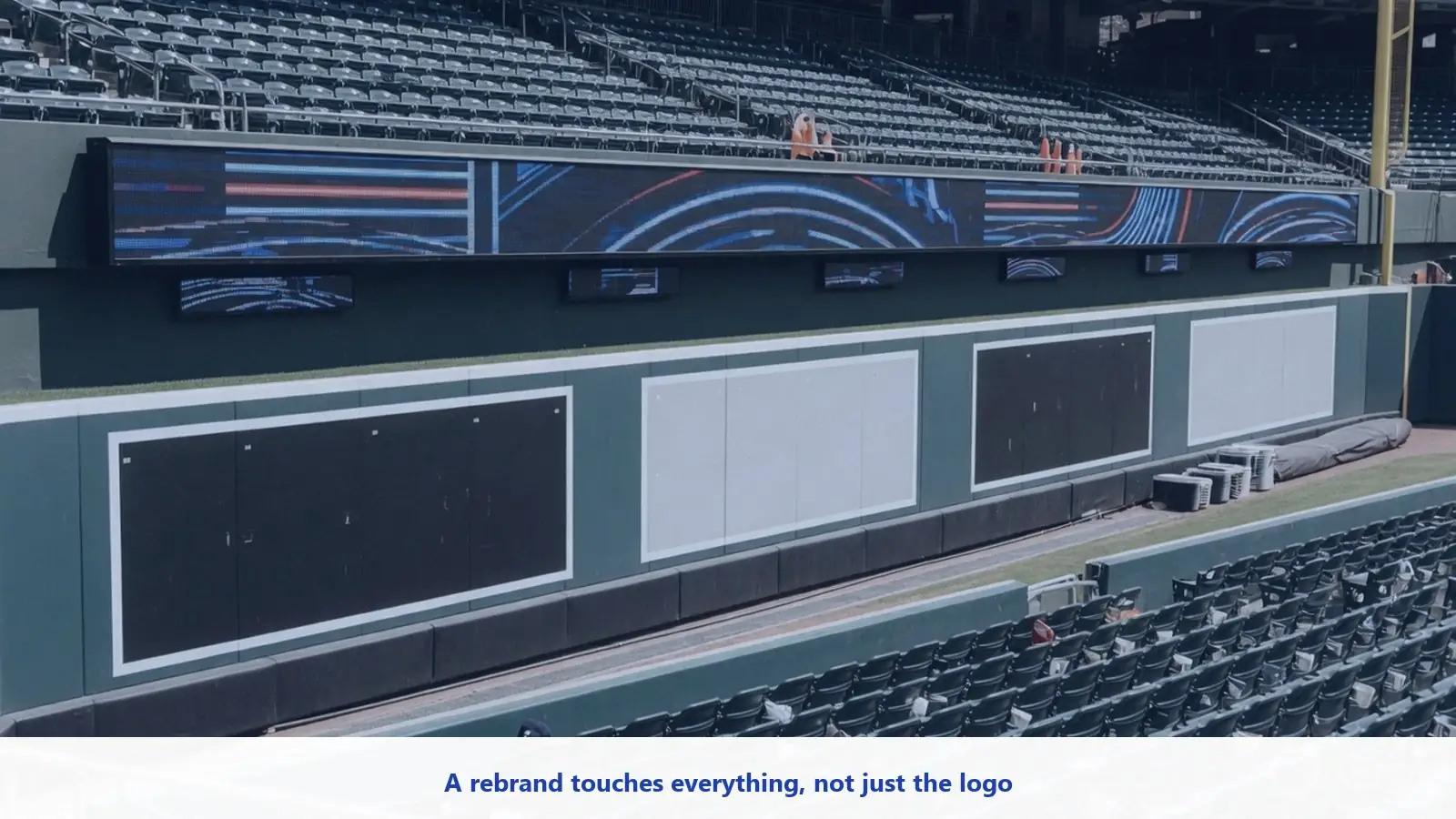
The Esko story is a useful, concrete inventory of what removing a brand actually involves once you get past the logo file:
- Signage and imagery across a football stadium and gym
- Flooring with motifs built directly into commons or court surfaces
- Furniture and fixtures bearing the old name
- Clocks, uniforms, and printed materials
- Budget lines that were never planned years in advance
None of this shows up in a rebrand announcement. All of it determines whether the rebrand actually feels finished to the people who see it every day. A homepage can change overnight. A gym floor cannot.
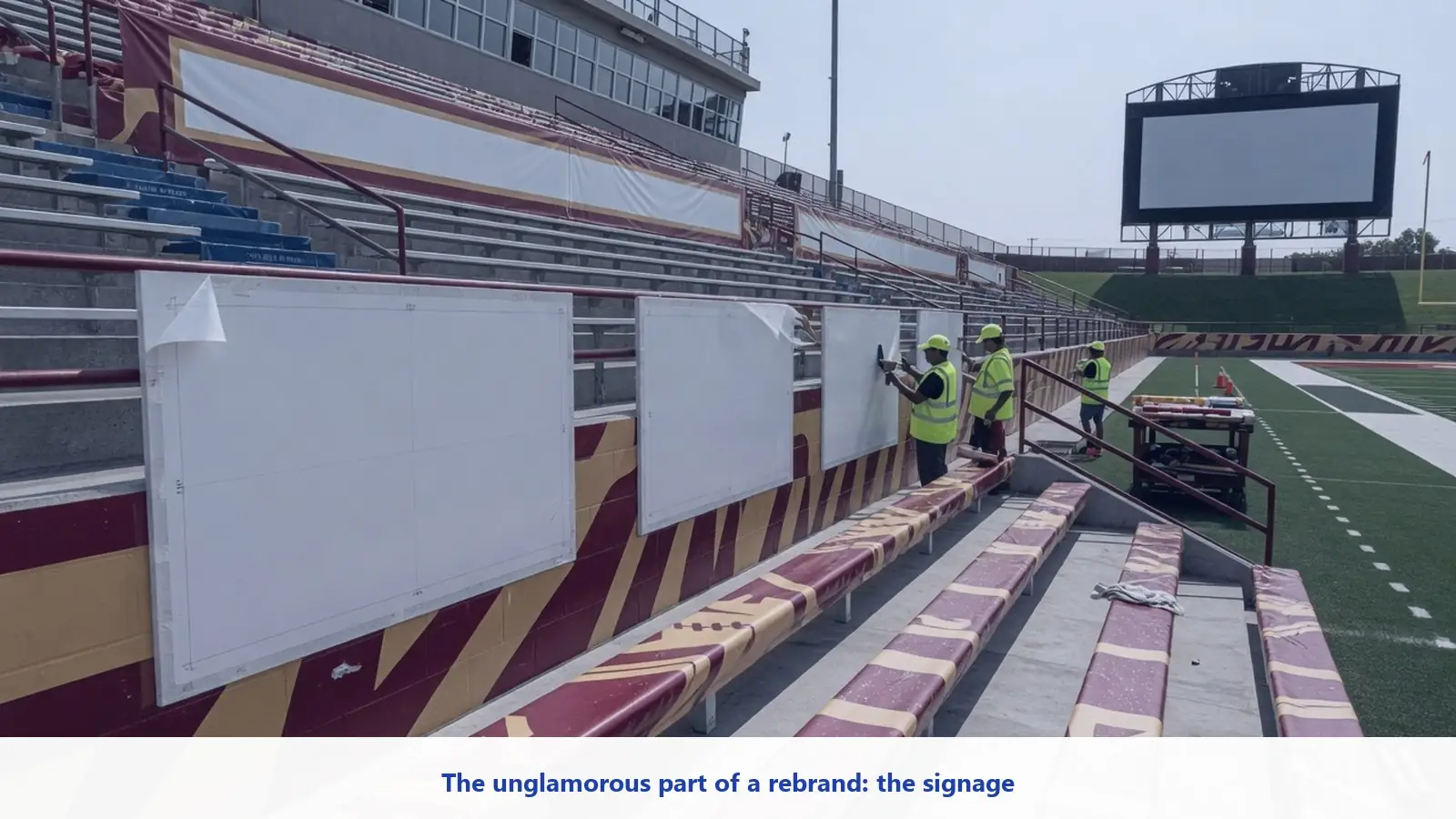
This is also where brand-led website experiences become part of the same project, not a separate redesign. If the website, social profiles, and physical environment disagree for months, audiences experience the brand as unfinished even when leadership thinks the transition is "done."
6 Mascot Rebrand Lessons From the Commanders to Esko
Lesson 1: Legacy branding hides in more places than you think
Esko's superintendent described the school as very branded out. Old branding turns up in flooring, furniture, and fixtures long after anyone thinks to look for it. Companies hit the same wall with packaging variants, partner co-branded PDFs, email footers, sales decks, and forgotten ad accounts.
Lesson 2: A rebrand budget is a real line item, not an afterthought
Removal alone costs real money. Esko's district had to find funding for it with no state assistance, the same way any company has to budget removal separately from the fun part: the new design. If your estimate only covers strategy and logo exploration, it is not a rebrand budget. It is a design budget with a cleanup surprise waiting.
Lesson 3: Deadlines force decisions that "someday" never would
A legal deadline is what is actually moving Esko's project to completion. Brands without an external deadline should consider setting one internally, because eventually rarely finishes a rebrand. Pick a ship date for full removal, then work backward into vendor lead times and seasonal constraints.
Lesson 4: Community buy-in matters more than design taste
Both the Commanders' and Esko's transitions involved public debate about the old name and what should replace it. That is a reminder that a rebrand's success depends as much on the people living with it as on the design itself. Taste is subjective. Continuity of communication is not.
Lesson 5: Interim branding beats rushed branding
Esko's teams have competed simply as Esko for two years while the full identity work happens. That is proof that a placeholder identity is better than forcing a final one before it is ready. A clean interim system protects credibility while the permanent brand catches up.
Lesson 6: The removal phase is as important as the reveal
The Commanders' and Guardians' name reveals got the headlines. The months of stadium, merchandise, and signage work afterward are what actually made the rebrands real. Esko is living through that same unglamorous phase right now. Treat removal as a deliverable with owners, budgets, and QA, not as leftover facilities work.
Most organizations underestimate how much of a rebrand budget and timeline needs to go toward this rollout phase, not just the new design itself. Short Stereo's website design services are built with this full rollout in mind, not just a new look, but a plan for where the old brand still needs to come out.
What Brands Should Implement Before Their Own Rebrand
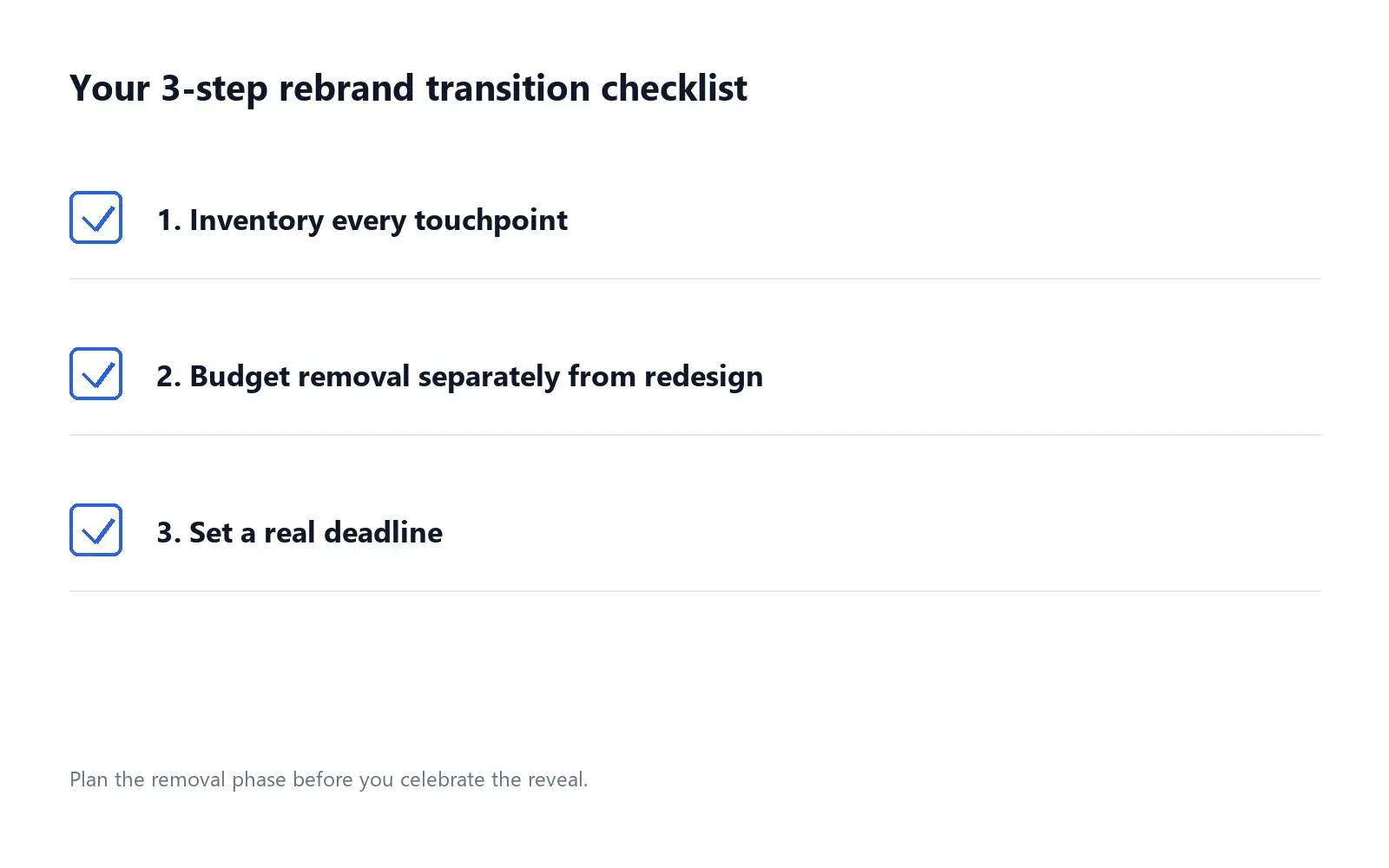
You do not need a state law to force better rebrand discipline. Start with three moves:
Inventory every physical and digital touchpoint
Before any redesign work starts, walk your own campus: office signage, packaging, email templates, social profiles, partner materials, and archived templates. List everywhere the old brand actually lives. If you skip this, your launch plan will underestimate both cost and calendar.
Budget removal separately from redesign
Treat the cost of taking the old brand down as its own line item, not something absorbed into the design budget after the fact. Include vendor removal, reprinting, residual inventory write-downs, and digital migration labor.
Set a real deadline, even a self-imposed one
Esko's project is finishing because it has to. Give your own rebrand a hard date, and treat it the same way. Consistency during the transition matters as much as the final result. A half-updated brand across web and social can look worse than the old one. This is where social content systems built for brand consistency tend to make the visible difference fastest during a rollout. Pair that with AI-assisted content and growth workflows so every channel updates with the same naming and visual rules.
Where Most Brands Get This Wrong
The most common mistake is treating the reveal as the finish line. The Commanders, the Guardians, and now Esko all show the same pattern: the new name or logo is just the starting gun for a much longer, less exciting removal-and-replacement process. Brands that do not plan for that phase end up with a new identity that only exists on the homepage while the old one still lingers everywhere else.
The second mistake is under-communicating interim states. Employees, customers, and partners need to know what is changing now, what is temporary, and when the full system lands. Silence creates rumor. A clear transition map creates patience.
How Short Stereo Helps Brands Finish a Rebrand
If your brand is planning a transition and needs help with the part that is not just the new logo, Short Stereo's design and motion work spans brand systems, websites, and content operations so organizations can plan a rebrand rollout that actually finishes. The useful standard is simple: when a customer walks into your physical or digital environment, the old brand should no longer be the loudest thing in the room.
Conclusion
A small Minnesota school district removing an old mascot from its gym floor does not look like it belongs in the same conversation as the Washington Commanders or the Cleveland Guardians. It is running the exact same playbook, just at a different scale and budget. These mascot rebrand lessons are practical: legacy branding hides in more places than expected, removal costs real money, and the reveal is only the beginning. Any brand planning a transition should treat the rollout, not just the redesign, as the real work. If you want help turning that inventory into a finished system, start at shortstereo.com.
Frequently Asked Questions
What happened with the Esko school mascot rebrand?
Esko Public Schools in Minnesota discontinued its Eskomos mascot and igloo imagery in 2023 following a state law banning Native American mascots, and is now in the final phase of physically removing the old branding from campus ahead of a September 2026 deadline.
How is this similar to the Washington Commanders or Cleveland Guardians rebrands?
All three cases involve a name and identity change followed by a long, resource-intensive process of replacing signage, merchandise, and other physical touchpoints, the unglamorous work that happens after the announcement.
How much does a full legacy brand removal actually cost?
Costs vary widely, but they include signage, flooring, uniforms, printed materials, and digital assets. Esko's district had to find this funding without state assistance, illustrating that removal is a real, separate budget line, not a footnote to redesign costs.
What can a small business learn from a school district's rebrand?
That legacy branding is often more widespread than expected, that removal deserves its own budget and timeline, and that a hard deadline, even a self-imposed one, is often what actually gets a rebrand finished.