A landmark Meta social media settlement can look like the end of the story. Billions change hands. Instagram and Facebook get harder teen defaults. Headlines move on. For founders, CMOs, and design leads, that reading is incomplete. The deal answers a legal case. It does not automatically repair every brand journey that still rewards unbounded attention.
This briefing reframes the Meta settlement for brand and growth teams: what changed for consumers, what still remains open, and what to implement in experience design, websites, social systems, and AI content before customers, partners, or regulators ask harder questions.

Public summaries from state attorneys general describe a multistate deal with Meta Platforms covering Instagram and Facebook teen experience rules plus payments reported in the mid-teens of billions of dollars, with some totals rising toward about $18 billion depending on contingent terms. Official detail is available from the Washington State Attorney General announcement. The brand question is sharper: what does "enough" mean when your product, ads, or community still copies pre-settlement growth habits?
Why Meta's Social Media Settlement Dominates Brand Search
People search Meta settlement news because Meta, Instagram, and Facebook sit inside daily consumer habits and daily media budgets. A courtroom concession of this size resets expectations for what "responsible design" looks like, even for companies that never appear in the same lawsuit.
Searchers are not only asking what happened. They are asking whether engagement-first product patterns are still safe to market. That is why Meta branding, Meta marketing, and experience design queries spike together. The famous brand is the hook. The business decision is the intent.
If your roadmap still treats time-on-platform as an uncomplicated win, the settlement is a weather report you cannot ignore. Partners, parents, and enterprise buyers now have a clearer public reference for safer defaults.

What Changes for Consumer Experience on Instagram and Facebook
Reported terms include default daily time limits for teens across Instagram and Facebook, mandatory pauses during continuous use, overnight access blocks, and quieter notification windows during school hours. Parents can often override settings, which means the lived experience will vary household by household.
Consumers will feel friction with a purpose. That can feel like restriction. It can also feel like respect. Brands that only optimize for session length may find users preferring products that help them leave in a good state.
Digital brand identity now includes the ethics of the interface, not only the polish of the logo. App reviews, support tickets, and partner diligence will increasingly ask whether your product designs for user goals or for retention charts alone.

5 Reasons Meta's Social Media Settlement Still Isn't Enough
1. It covers Meta first, not every attention product
Instagram and Facebook changes matter. They do not rewrite TikTok, YouTube, Snap, gaming apps, or your own product overnight. Meta even urged peers to join comparable terms. Until that happens at scale, teens and adults can still move to looser environments. Brand teams that advertise or build across multiple surfaces still need their own standards.
2. Money does not automatically rebuild trust claims
A large payout funds state programs and closes litigation risk for Meta. It does not rewrite your homepage, onboarding, or social captions. If your marketing still promises calm control while the product uses urgency and endless loops, the trust gap remains. Claims must match defaults.
3. Defaults communicate brand values louder than press releases
The settlement hard-codes safer defaults for teens on Meta apps. For any brand, defaults tell users what you believe is healthy. Hidden settings that bury safer options read as intentional. Make the responsible setting the easy setting, then market that reality honestly.
4. Growth systems can still copy old pressure patterns
Even after Meta's social media settlement, many acquisition playbooks still lean on fear of missing out, countdown timers, and notification stacks. A durable social media system can drive demand without modeling extractive attention. Post less manufactured scarcity and more proof of product respect.
5. Brand websites still overclaim what products under-deliver
Trust pages, age policies, and plain-language limits belong in the experience, not a buried PDF. Strong brand-led website experiences turn policy into usable interface. If customers cannot find how to pause, limit, or leave within a few taps, your trust story is incomplete even when industry headlines sound resolved.
Brand and Visual System Implications
Visual systems after a Meta settlement should signal clarity, not just energy. That means quieter urgency language, clearer age and parental messaging, and interface patterns that celebrate healthy exits as much as deeper sessions. Motion and video should demonstrate control, not only dopamine.
For Meta marketing teams and adjacent advertisers, creative that glamorizes endless scrolling now ages badly next to public teen-limit headlines. Recalibrate brand films, paid social, and product demos so the hero moment is useful completion, not trapped attention.
What Brands Should Implement This Quarter
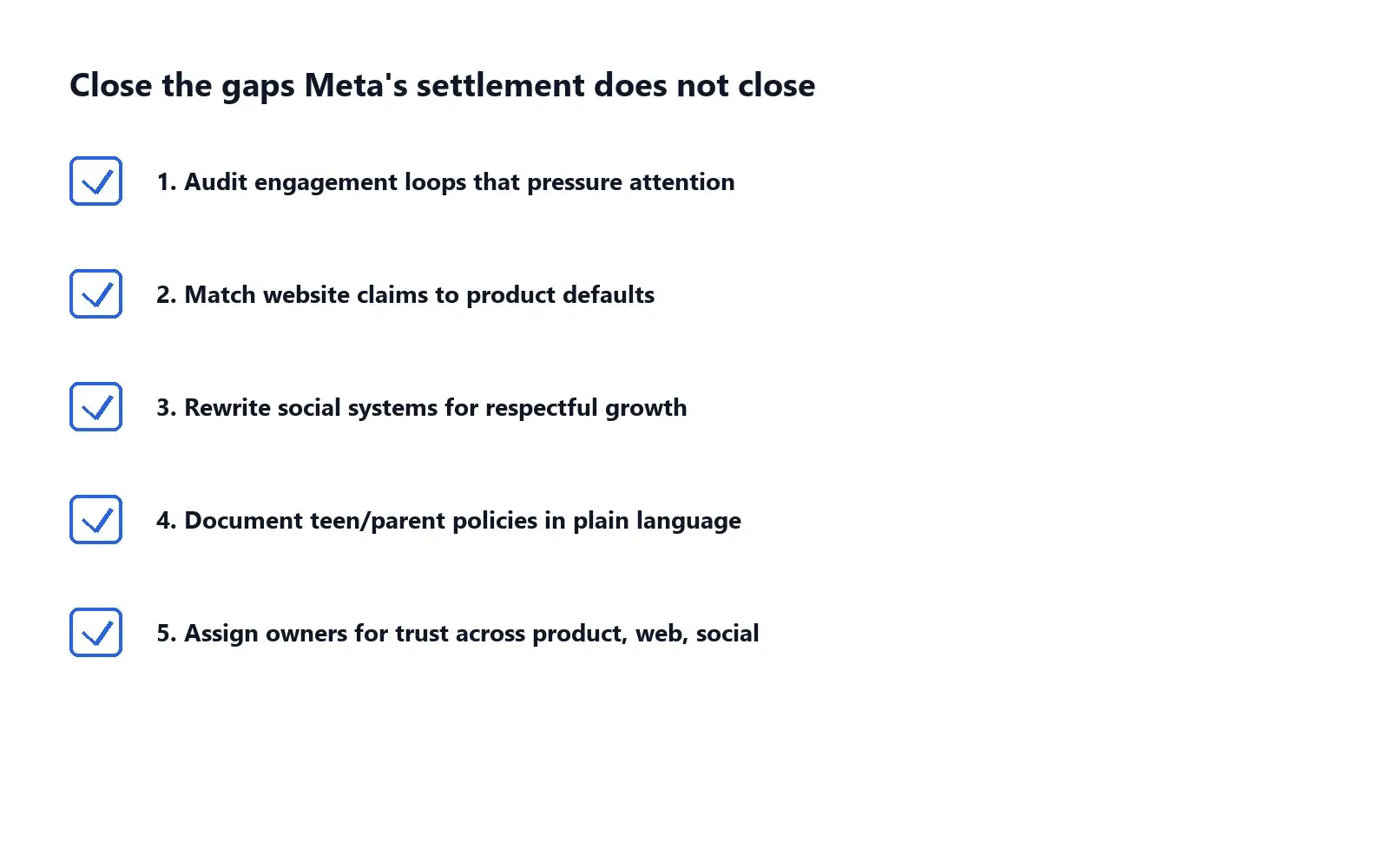
- Map your top retention loops and mark which ones create pressure.
- Rewrite homepage and onboarding claims so they match product defaults.
- Audit notifications for timing, frequency, and urgency language.
- Publish a short trust page with plain limits and support paths.
- Use AI-assisted content and growth workflows to keep policy explanations accurate without overclaiming.
- Assign owners across product, web, and social so messaging stays aligned.
Consistency during the transition matters. A half-updated brand across web and social can look worse than an honest old system. Treat trust as a shared deliverable with a date, not a soft values slide.
Where Most Brands Get This Wrong
The most common mistake is treating Meta's settlement as someone else's legal story. The second is celebrating industry headlines while leaving engagement dark patterns untouched in your own funnel. The third is letting AI draft trust copy faster than product reality can support it.
Enough, for a brand team, means your experience can survive daylight: clearer onboarding, measurable wellbeing outcomes where relevant, fewer fake urgency patterns, and brand messaging that can be defended with counsel and with customers in the same meeting.
How Short Stereo Helps Brands Respond
Short Stereo helps teams turn settlement-era expectations into practical systems: clearer product journeys, websites that state limits without legal fog, and social content that matches what the product actually does. After a Meta social media settlement this large, the brands that win are the ones that can prove respect in the interface, not only quote the news in a campaign.
Conclusion
Meta's social media settlement is a major consumer-protection signal for Instagram, Facebook, and the wider attention economy. It is still not enough to finish your brand's work. The gaps remain in cross-platform standards, trust claims, defaults, growth systems, and website honesty. Close those gaps now, while you can still choose the changes instead of reacting under pressure. If you want help turning that into a practical brand and website system, visit shortstereo.com.
Frequently Asked Questions
What is Meta's social media settlement?
Meta agreed with most U.S. states to pay up to roughly $17 to $18 billion over about a decade and add default teen safety features on Instagram and Facebook, including daily time caps, nighttime blocks, and other limits, pending court approval.
Why do some commentators say Meta's settlement is not enough?
The deal covers Meta platforms and contingent industry conditions. It does not automatically reset product norms for every app, advertiser, or brand journey, and critics argue teens can still move to other platforms without matching rules.
What changes for Instagram and Facebook teen users?
Reported terms include a combined daily time limit across Instagram and Facebook, mandatory pauses during continuous use, overnight access blocks, quieter school-hour notifications, and stronger parental controls.
What should brand teams do after the Meta settlement news?
Audit engagement loops, align website claims with product defaults, redesign social systems for respectful attention, publish plain-language youth policies, and assign cross-team owners for trust.