Engadget's question, is 4K marketing more than a technical label, is the kind of mainstream search prompt founders and CMOs should study. Shoppers type "4K" when they buy TVs, monitors, cameras, and streaming plans. The word is famous. The lesson is not pixel trivia. It is how naming shapes trust, shelf decisions, and product-page clarity.
4K began in cinema as a horizontal resolution near 4,000 pixels. Consumer living rooms mostly got Ultra HD at 3840 x 2160, still four times the pixel count of 1080p, then watched Sony, Samsung, LG, Netflix, and Apple ecosystems turn the label into a default expectation. When a name outlives the pedantic math, brand systems either explain it or lose the trust fight.

Coverage of "Is 4K Just Marketing? Here's Where The Name Really Came From" sits in a long industry argument: DCI cinema 4K versus consumer Ultra HD, and why retailers still print the shorter word. Authoritative glossaries from groups like the Consumer Technology Association show how 4K Ultra HD became a consumer education category. For non-TV brands, the useful question is how to name a technical advantage without sounding like buzzword theater.
Why 4K Marketing Matters to Searchers
People search 4K meaning, 4K vs 8K, and 4K explained because the label sits on nearly every big-screen aisle. It is one of the highest-intent consumer tech terms in weekly Google demand. When Engadget asks if 4K is just marketing, searchers want the origin story and a trust verdict.
Brand leaders search the same story for a different payoff. They want a portable rule for product naming: when is a shorthand helpful, when does it confuse, and how do websites, packaging, and social posts keep one definition. Famous entities create demand. Your job is to convert that demand into clearer branding strategy and experience design on your own pages.
That is why 4K belongs in a marketing brief even if you do not sell televisions. Any business shipping technical claims, AI features, speed scores, or sustainability metrics faces the same naming trap: a catchy label that outruns the fine print.
Searchers bouncing from "is 4K just marketing" headlines want a verdict they can use at checkout and on a product roadmap. Give them both: the origin story, and a naming checklist that works for SaaS tiers, hardware badges, and campaign slogans alike.

What Changes for Consumer Experience
Consumers do not walk into a store asking for 3840 x 2160. They ask for 4K. The name compresses a complex upgrade into a buyable cue, then streaming catalogs from Netflix and peers reinforce the expectation at home. Experience design for brands selling technical products must assume customers arrive with slogan-level vocabulary and need plain-language proof before they trust the price.
Confusion appears when packaging says 4K, the FAQ says Ultra HD, and the comparison chart uses 2160p. That mismatch feels like bait even when the pixels are real. A coherent website design system and disciplined social media branding should keep the hero label, the definition, and the proof in the same sentence family.
Trust is the consumer experience change that matters. Shoppers forgive a simplified name. They punish a name that cannot survive a follow-up question on the product page.

Brand and Visual System Implications of Naming Like 4K
4K is a visual system problem as much as a copy problem. The badge appears on boxes, endcaps, hero banners, app filters, and comparison tables. Once a mark becomes famous, every surface must answer: what does this mean in one line, and what proof sits next to it?
Brand systems should prepare for three pressures. First, slogan density rises, so typography and hierarchy must keep the proof readable beside the badge. Second, digital brand identity needs a glossary module customers can find without digging through PDFs. Third, campaign creative must avoid stacking vague superlatives on top of an already compressed technical name. Branding strategy here is clarity under fame, not more adjectives.
Sony, Samsung, and LG did not invent cinema 4K, but their retail language taught the market which word to memorize. Netflix and other platforms taught which word to filter by. If your category has a similarly sticky label forming, design the definition early or competitors will own the meaning for you.
Visual systems should also resist logo theater. Do not plaster competitor marks to borrow authority. Build your own badge hierarchy, glossary block, and comparison chart so customers can verify claims without leaving the page. That is digital brand identity with marketing honesty built in.

7 Marketing Lessons Brands Can Learn From the Word 4K
1. Short names beat precise names when customers are in a hurry
2160p is more consistent with older vertical naming. 4K won because it is shorter and sounds like an upgrade. If your technical truth needs a long string, invent a short hero name, then immediately translate it.
2. Borrowing cinema prestige is a branding move, not a crime
Consumer 4K is usually Ultra HD math with a cinema-born nickname. The lesson is not to invent fake history. It is to understand how prestige transfer works, then keep the relationship honest on the page.
3. Pair every slogan with one plain-language proof line
4K works best when packaging or copy adds Ultra HD, pixel counts, or "four times Full HD" context. Your product badges need the same companion line so curiosity does not turn into suspicion.
4. Align shelf language with website language
If the box says one thing and the PDP says another, customers assume spin. Build a naming sheet shared by packaging, web, ads, and support. Experience design fails when channels disagree about the definition.
5. Famous brands accelerate adoption of a label
Once major TV makers and streamers normalize 4K, late movers look outdated even if their specs are fine. Watch which words category leaders repeat, then decide whether to match, redefine, or differentiate on purpose.
6. Educate without talking down
People searching 4K explained want a clear answer, not a lecture. Use diagrams, comparison tables, and FAQs. Scale that education with AI content workflows that stay on the approved definition instead of inventing new jargon weekly.
7. Assign one owner who can reject clever confusion
Marketing loves bigger numbers. Product and legal need measurable claims. Give one owner veto power over hero labels that cannot survive a customer support ticket. That owner protects brand trust more than another slogan brainstorm.

What Businesses Should Implement This Week
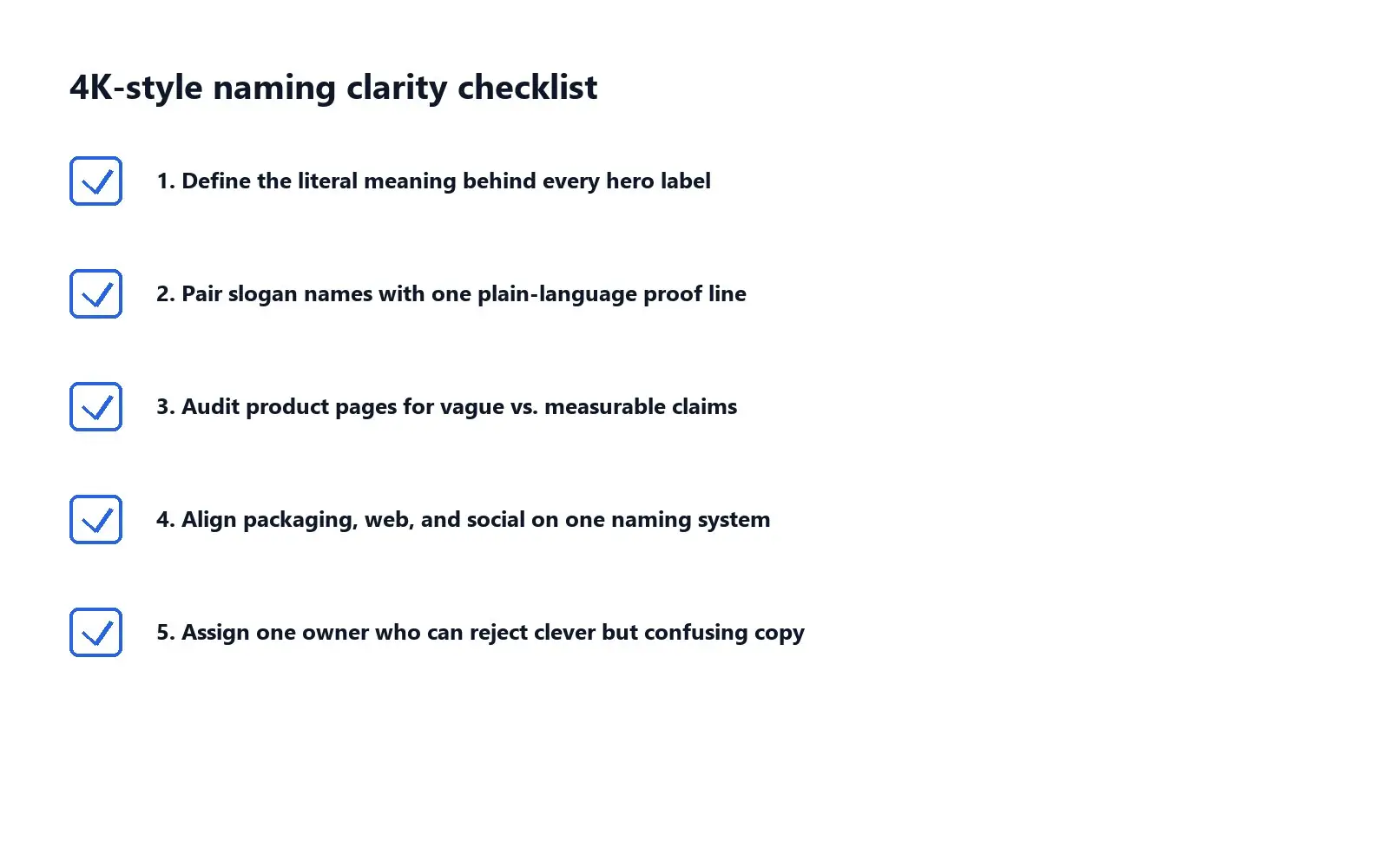
- List every hero label on packaging, homepage, and ads, then write the literal meaning in one sentence.
- Add a proof line under each badge (measurement, comparison, or standard body).
- Audit the product page FAQ for conflicts between marketing names and spec tables.
- Publish an internal naming sheet for web, social, packaging, and support.
- Choose one owner who can reject copy that sounds clever but fails a trust test.
- Schedule a 30-day review after your next launch to catch naming drift early.
Consistency during a naming trend matters more than inventing a flashier badge. Customers forgive a calm, clear system. They punish confused promises. Use 4K marketing coverage as a forcing function to tighten your own language before the next campaign ships. If your next launch depends on a new technical nickname, write the one-sentence definition and proof line before the creative team designs the badge.

How Short Stereo Helps Brands Apply Naming Clarity
Short Stereo helps teams turn mainstream marketing trends into practical identity systems: clearer websites, on-brand social, and AI-assisted content that does not invent claims. After debates like whether 4K is just marketing, the brands that win are the ones that can keep one definition intact across packaging, product pages, and campaigns.
Conclusion
4K marketing matters because the word is one of the most searched buying cues in consumer tech. Cinema gave it prestige. Retail and streaming made it habit. The seven lessons above, short names with proof, aligned channels, education without condescension, and an owner who can veto confusion, help any business name technical value without burning trust. Close those gaps now, while you can still design the language instead of reacting under launch pressure. If you want help turning that into a practical brand and website system, visit shortstereo.com.
Frequently Asked Questions
What does 4K actually mean?
4K refers to a horizontal resolution of roughly 4,000 pixels. Cinema DCI 4K is 4096 x 2160. Most consumer TVs sold as 4K use Ultra HD at 3840 x 2160, about four times the pixels of 1080p Full HD. The K stands for kilo, thousand.
Is 4K just marketing?
4K began as a cinema production label, then became consumer shorthand. The pixel jump is real, but the word outgrew precise math. Brands like Sony, Samsung, LG, and streamers popularized 4K as a purchase cue, often pairing it with Ultra HD on boxes and product pages.
What is the difference between 4K and Ultra HD?
Strict cinema 4K is 4096 x 2160. Consumer Ultra HD (UHD) is typically 3840 x 2160. Retail marketing often blends the terms as 4K UHD because shoppers recognize 4K faster than vertical-line names like 2160p.
What can brand teams learn from 4K marketing?
Pair catchy labels with plain-language proof, publish one definition customers can trust, keep packaging and website language aligned, and never let slogan names outrun measurable claims on product pages.