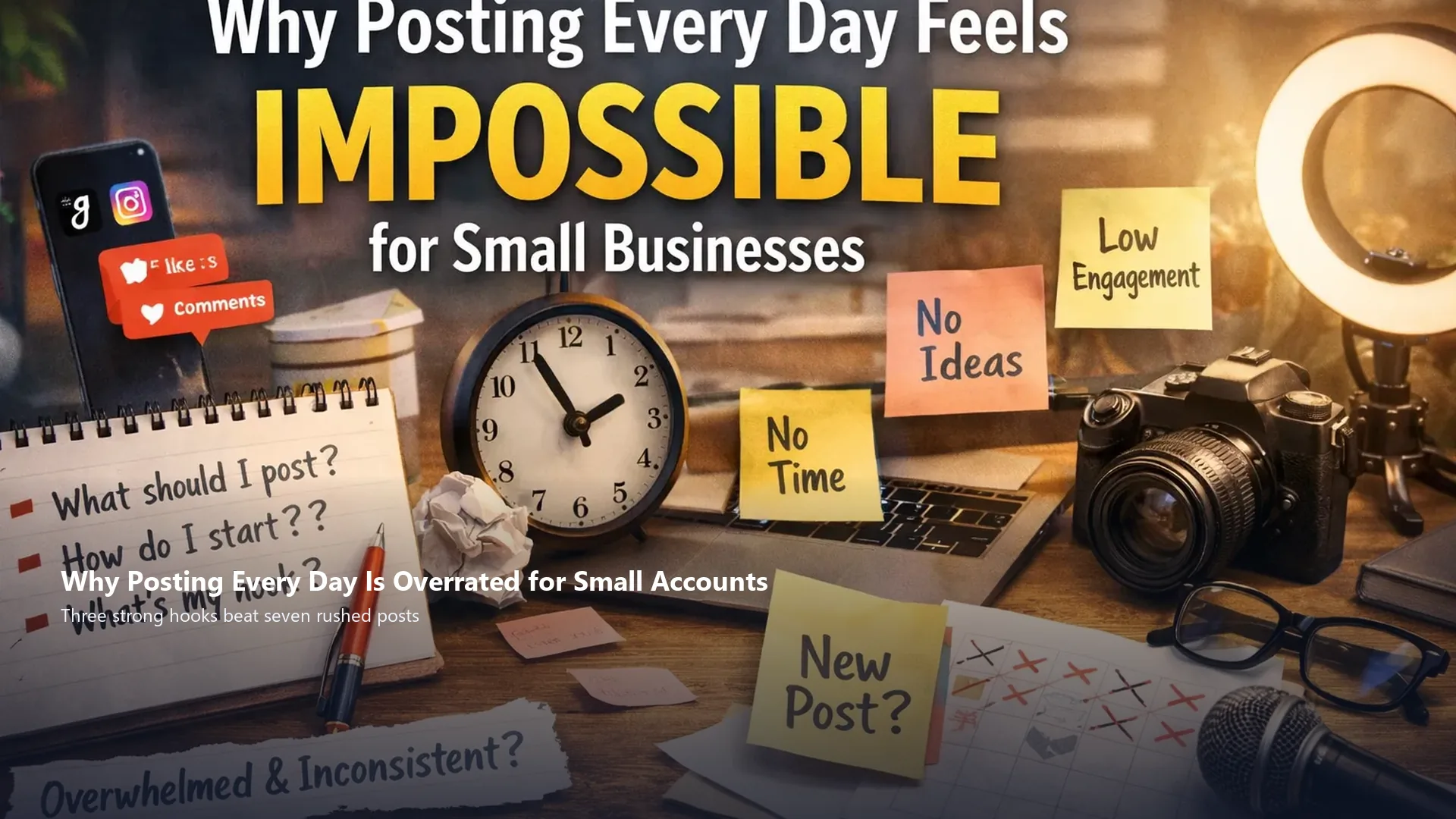
If you have heard that posting every day is the only way for small accounts to grow, you are not alone. The advice is loud, simple, and often wrong for founders and marketers without a content team. Daily volume can look productive while quietly training filler, weak hooks, and burnout by week three.
That exact tension showed up in an r/socialmedia thread arguing that posting every day is overrated for small accounts. The practical claim was clear: three posts a week with a real hook can beat seven rushed ones, and daily cadence mostly works for people who already have a system or a team. This article reframes that community pain into branding, experience design, and business decisions you can apply without inventing engagement stats or promising outcomes.
What the Daily Posting Myth Gets Wrong
Platforms reward relevance, recognition, and completion signals. They do not automatically reward the act of showing up with unfinished creative. When a small account forces a daily slot, the first casualty is usually the hook. Captions get vague. Visuals look recycled without intention. The profile starts to feel busy rather than trustworthy.
Daily posting can still be useful later. Once templates, roles, and a clear offer exist, higher frequency is easier to keep. Until then, cadence becomes a stress test that most tiny teams fail. The myth treats volume as strategy. Branding treats volume as an output of a system you can actually run.
Founders often copy creator advice built for people who already film, edit, and reply as a full-time loop. A small account with one operator has different constraints. Your competitive advantage is clarity of offer and proof, not calendar density. Treat social as a designed brand surface, then decide how often that surface can stay sharp.
The Real Cost of Filler Content for Small Accounts
Filler does more than waste time. It trains your audience to skim. It teaches your team that shipping something is more important than saying something. It also muddies digital brand identity: colors drift, offer language changes weekly, and the website promise no longer matches the feed.
For small accounts, attention is scarce. Every weak post spends a little trust. Experience design on social is the craft of making each surface feel intentional, mobile-readable, and connected to a next step. That craft collapses when the only KPI is "did we post today?"
There is also an internal cost. Operators who burn out by week three often disappear for two weeks, which breaks the consistency they were chasing. A lighter cadence you can keep for a quarter beats a heroic daily streak that collapses. Brand memory compounds when people see the same promise delivered well, not when they see random activity.
Practical move
Audit the last two weeks. Mark posts that had a clear hook, a recognizable brand cue, and a next step. If most fail those three checks, reduce frequency before you increase it.
Why Three Strong Hooks Beat Seven Rushed Posts
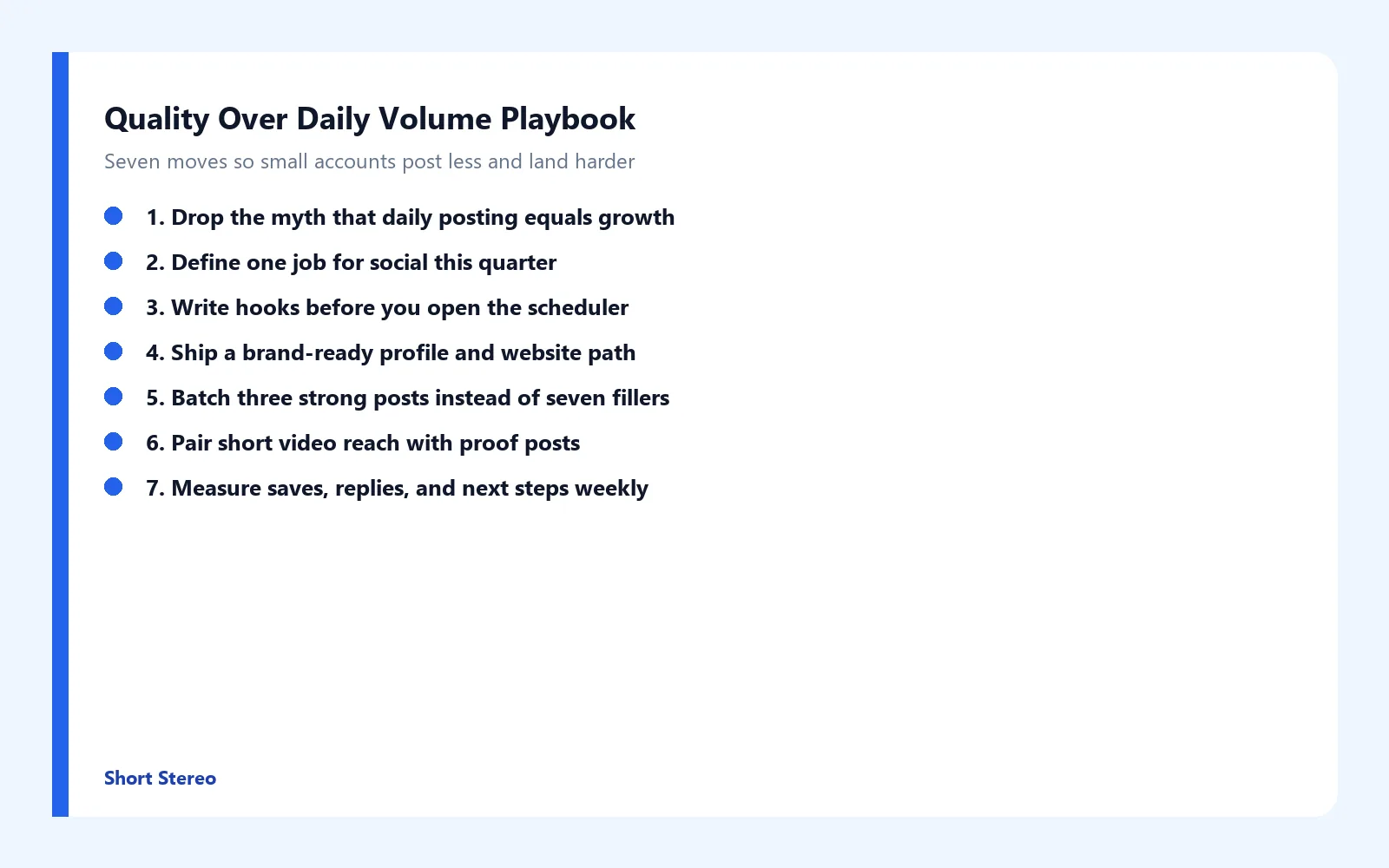
A hook is the first second of a Reel, the first line of a caption, or the headline on a static card. It answers why someone should stop scrolling. Three posts with sharp hooks give your brand three chances to be remembered. Seven rushed posts often give seven chances to be ignored.
This is not a claim that three is magic for every niche. It is a design rule: quality density beats calendar density when resources are thin. Write the hook before you open the scheduler. If you cannot state the problem, result, or proof in one line, the post is not ready.
Hooks also force brand decisions. They make you choose which customer problem you are known for. That choice is branding strategy in public. Over time, a small account that repeats a sharp promise builds a digital brand identity people can describe in one sentence. A small account that posts daily without a promise becomes noise.
Branding Changes That Make Fewer Posts Work Harder
If daily posting feels overrated, the fix is rarely "post less and hope." The fix is brand architecture that makes each asset recognizable.
- One offer line that matches your website homepage.
- Profile photo, cover, and highlight covers that share the same palette and type.
- Four reusable frames: education, proof, process, and offer.
- Mobile-first hierarchy so the first three words still read on a phone.
When visitors from a Reel land on your site, they should feel they entered the same brand world. That is where website design and social creative meet. Consistency turns a lighter calendar into a clearer storefront.
A Weekly Content System That Survives Busy Weeks
Replace "post something every day" with a weekly production block. Choose one primary platform. Draft three assets with hooks written first. Design them inside your template set. Schedule, then stop. Protect founder time for sales, delivery, and product work.
Operators who rely on social media systems usually win because design decisions happen once and reuse for weeks. Support drafting with AI content workflows, then edit for accuracy and brand voice. Automation helps the system. It does not replace judgment about what deserves a slot.
Keep a simple scoreboard: profile visits, link clicks, quality replies, and booked next steps. Ignore vanity streaks. If a quieter week still produces clear creative and useful conversations, your system is working. If a louder week produces filler and no next steps, volume was theater.
Practical move
Block one half-day for production. No scrolling. Export, schedule three posts, and leave the rest of the week for replies that matter.
How Video and Social Design Support Selective Posting
Short video often earns distribution faster than quiet static posts, especially when ad budgets are thin. Open on the problem or result in the first second. Keep branding visible. End with a clear next step. One strong demo can become a Reel, a tip card, and a longer caption post without inventing seven new ideas.
Static posts still matter for proof, FAQs, and brand memory. Together they reduce the need to invent something new every morning. Align the promise in the feed with the post-click path so attention can become a conversation.
Selective posting is easier when creative is modular. Film one process clip, cut three openings, and pair each with a different proof line. Design the end card once. That is motion and branding working as one system, which is how small accounts stay visible without living inside the apps.
When Daily Posting Actually Makes Sense
Daily cadence is not always wrong. It can work when you already have a system or a team: templates locked, approvals clear, brand voice documented, and someone responsible for hooks. News-driven niches, live commerce, or high-volume education libraries sometimes need more frequent surface area.
Even then, daily should mean designed daily, not desperate daily. If quality drops, cut frequency before you cut standards. Growth that depends on exhausted filler is fragile.
How Short Stereo Helps Small Accounts Build Sustainable Systems
After marketers ask whether posting every day is overrated for small accounts, the teams that improve usually fix brand clarity, templates, and website follow-through together. Short Stereo helps connect those pieces so visibility becomes easier to earn without burning the calendar.
Conclusion
Why is posting every day overrated for small accounts? Because volume without hooks trains filler, and filler spends trust. Prefer a weekly system with strong openings, coherent branding, short video paired with proof, and a website path that matches the feed. None of these moves guarantee followers, sales, or conversions. They improve the conditions under which people can trust you. If you want help turning that playbook into design and content execution, visit shortstereo.com.
Frequently Asked Questions
How can a design agency help with posting every day pressure?
A design partner clarifies the offer, builds a coherent brand system, designs reusable templates, and aligns website, social, and video so you can publish fewer, stronger posts without reinventing creative daily. Agencies do not guarantee followers, sales, or rankings.
What branding changes should businesses make if daily posting feels overrated?
Tighten the promise to one clear offer line, match profile and cover visuals to the website, standardize fonts and colors, and stop mixing unrelated products in the same feed. Brand consistency lets three strong posts feel intentional instead of seven unfinished ones.
How to use social media and video content without posting every day?
Batch short video and static posts in one session using a small template set. Lead video with the problem or result in the first second, keep branding visible, and end with a website or message next step. Keep a weekly cadence you can sustain, not a daily grind that collapses by week three.
Does daily posting work better once you have a team or system?
Often yes. Daily cadence is easier when templates, approvals, and roles already exist. For solo operators and tiny teams, forced daily volume usually trains filler. Build the system first, then raise frequency only if quality stays intact.
Is three posts a week enough for a small account?
Three posts with real hooks can outperform seven rushed ones when each asset has a clear job, recognizable branding, and a next step. Volume alone does not create trust. Consistency of message matters more than calendar density.